That used filter in your hand holds three months of trapped dust, pollen, and pet dander that never reached your family’s lungs. So before you drop your old 20x34x4 air filter in the recycling bin, know this: it almost certainly doesn’t belong there. At Filterbuy, we’ve manufactured air filters in the USA since 2013 and helped millions of homeowners stay on top of their air, and that means making the invisible visible right down to what you do with a filter once it’s done its job. Retiring one the right way takes about two minutes. Here’s exactly how.
TL;DR Quick Answers
20x34x4 Air Filters
A 20x34x4 air filter is a 4-inch-thick pleated HVAC filter with a nominal size of 20x34x4 inches and an actual size of 19.50 x 33.50 x 3.63 inches. The extra depth lets it trap more dust, pollen, and allergens while keeping airflow strong, so it protects both your family’s air and your HVAC system at once.
Actual size: 19.50 x 33.50 x 3.63 inches. Confirm it before buying, since this is a less-common size.
MERV options: MERV 8, 11, and 13 capture roughly 90%, 95%, and 98% of airborne particles.
Best for allergies or pets: choose MERV 11 to 13 to catch the fine stuff like pollen and pet dander.
Replace it: about every 90 days, or every 6 weeks with allergies and asthma, and roughly every 2 months with pets.
Where to get it: local stores rarely stock this size. Filterbuy makes 20x34x4 filters in the USA and ships them in 24 hours.
Top Takeaways
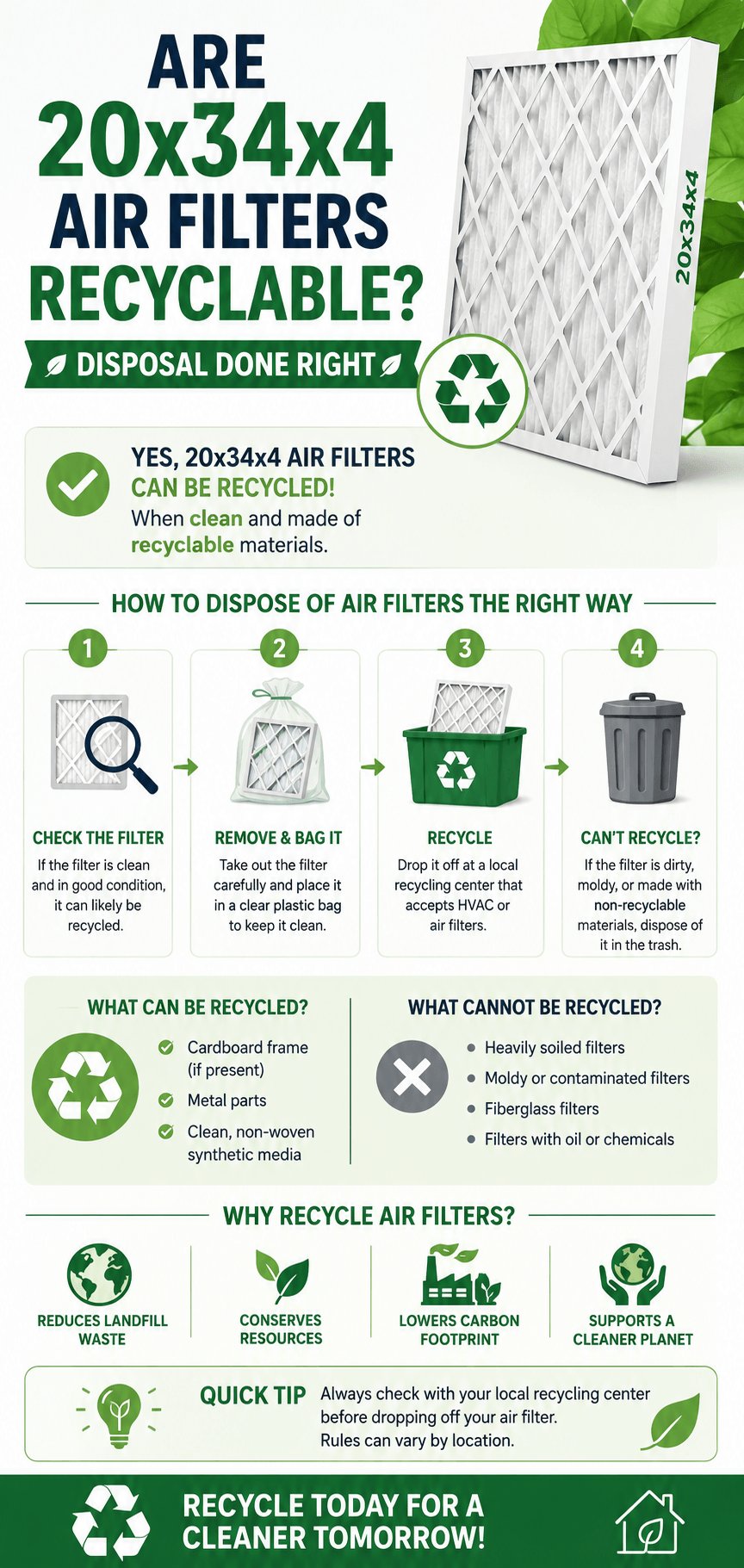
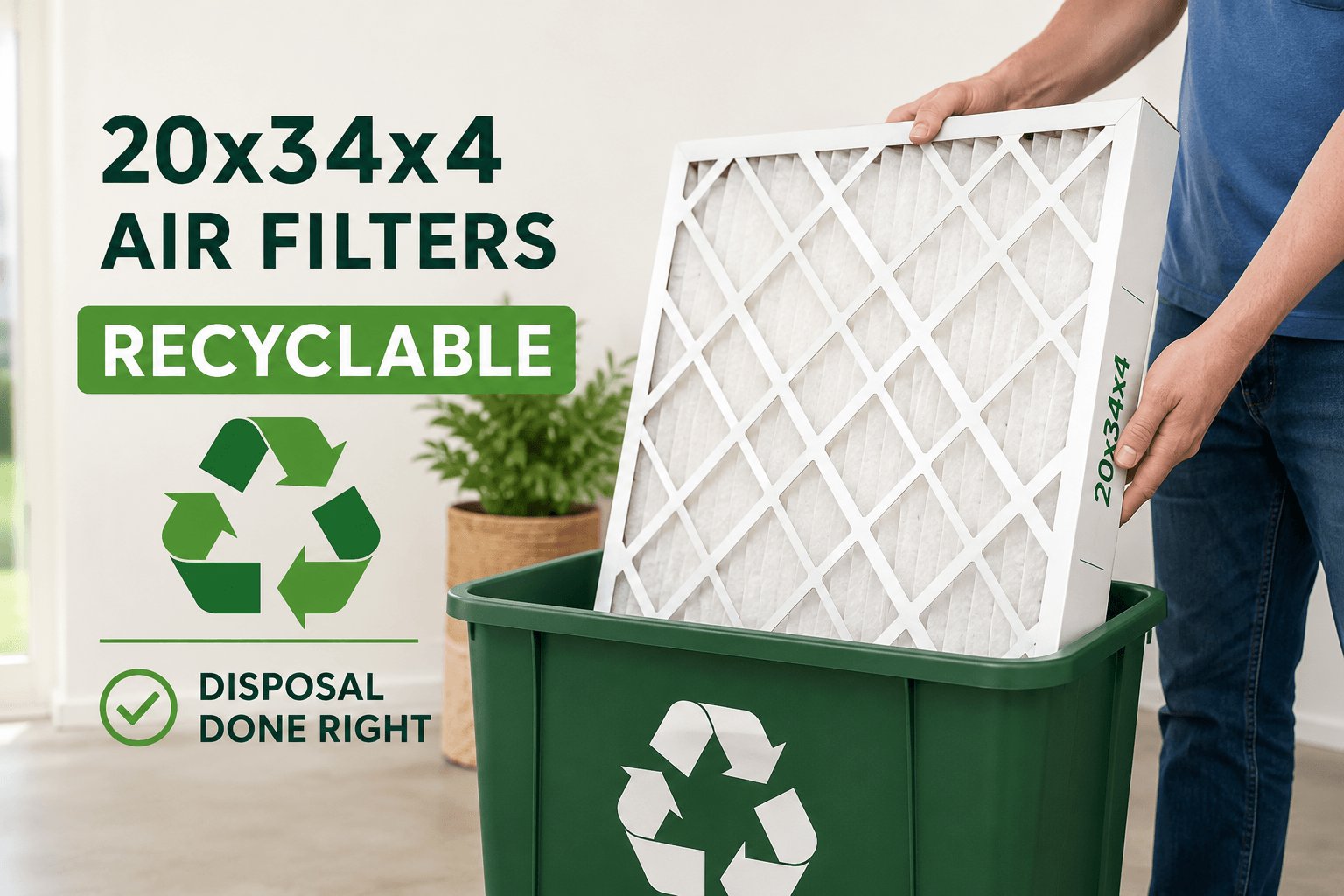
Most disposable 20x34x4 air filters aren’t curbside recyclable, because recycling centers can’t separate the cardboard, synthetic media, and metal backing.
The clean way to toss one: power down the system, pull the filter without shaking it, seal it in a bag, and use the outdoor trash.
Bagging matters most for allergen filters, since it keeps captured pollen and dander from drifting back into your air.
For zero recurring waste, a washable, reusable filter lasts years.
Replace with a correctly sized, pleated 20x34x4 filter, and go MERV 11 to 13 if anyone has allergies.
Change it on time. A clogged filter wastes energy, and heating and cooling already eat nearly half of a typical home’s energy use.
Why most 20x34x4 filters can’t be recycled
A standard 20x34x4 air filter looks simple, but manufacturers bond three materials together to build it: a cardboard frame, pleated synthetic media, and a thin metal or wire mesh that holds the pleats open. Each part could be recycled on its own. Together, they defeat most curbside programs, because recycling centers can’t separate them, so they pull the whole filter and send it to the trash. If you want the science of how that pleated media actually traps particles, this overview of an air filter breaks it down well.
What you can actually recover
You can sometimes cut the cardboard frame free and recycle it once you’ve stripped out the media, though most homeowners decide that’s more trouble than it’s worth. The cleaner long-term answer is a washable, reusable filter on an aluminum frame. It costs more upfront and lasts for years with regular cleaning, which keeps a stack of disposable filters out of the landfill.
How to retire a used 20x34x4 filter the right way
Here’s the routine we recommend, and the one our own team follows at home:
Turn off your HVAC system so it isn’t pulling unfiltered air while the filter is out.
Slide the old filter out slowly. No shaking. That keeps the trapped dust and allergens locked in the media instead of floating back into the room you just cleaned.
Seal it inside a plastic bag and close it tight.
Put it in your outdoor trash, not an indoor bin where the bag can tear.
Check your local waste rules if the filter ran in a workshop or another high-contaminant space.
Habits that cut filter waste
Right-size your filter so you’re not buying and tossing the wrong one twice. Change it on schedule so it works the way it’s built to. And choose a quality pleated filter made to last its full rated life, because fewer changes over the years means less waste headed to the curb.
Choosing the best 20x34x4 replacement
Once the old one’s bagged, the real question is what goes back in. A 20x34x4 filter has an actual size of 19.50 x 33.50 x 3.63 inches, so confirm that measurement before you buy. Look for pleated construction and a MERV rating that fits your home. Our 20x34x4 air filters are pleated, made in the USA, and ship in 24 hours in MERV 8, 11, and 13, capturing 90, 95, and 98 percent of airborne particles. Buying online also solves a real headache with this less-common size: search “20x34x4 air filter near me” and the local hardware store often comes up empty, so getting a 20x34x4 air filter nearby usually means having it delivered.
For households with allergies
If someone in your home fights allergies or asthma, a higher-MERV 20x34x4 allergen air filter earns its place. MERV 11 to 13 captures the fine particles that set people off, including pollen and pet dander. One more reason to bag and seal that filter on the way out. It’s carrying a season’s worth of the exact allergens you’re trying to keep out of the air, and a 20x34x4 air filter for allergies only helps if you retire the old one cleanly.
“After years of changing filters and fielding customer questions, we’ve found the costliest mistake comes after the filter’s out, not when you pick it. Shake a used one out over an open can and you’ve undone three months of clean air in about five seconds, so bag it, seal it, and put a fresh one in before the system runs again.”
— Filterbuy air quality specialist, 10+ years in residential filtration
7 Essential Resources
EPA — Guide to Air Cleaners in the Home: consumer guidance on picking and maintaining furnace and HVAC filters. https://www.epa.gov/indoor-air-quality-iaq/guide-air-cleaners-home
EPA — Air Cleaners and Air Filters in the Home: how filtration fits into cleaner indoor air. https://www.epa.gov/indoor-air-quality-iaq/air-cleaners-and-air-filters-home
EPA — What Is a HEPA Filter? a plain-language explainer on filter efficiency and types. https://www.epa.gov/indoor-air-quality-iaq/what-hepa-filter
U.S. Department of Energy — Air Conditioner Maintenance: why a clean filter protects efficiency and your equipment. https://www.energy.gov/energysaver/air-conditioner-maintenance
ENERGY STAR — Heat & Cool Efficiently: filter-change timing and HVAC efficiency tips. https://www.energystar.gov/saveathome/heating-cooling
EPA — The Inside Story: A Guide to Indoor Air Quality: the foundational overview of indoor air pollution sources. https://www.epa.gov/indoor-air-quality-iaq/inside-story-guide-indoor-air-quality
Wikipedia — Air Filter: technical background on filter media and how particle capture works. https://en.wikipedia.org/wiki/Air_filter
3 Statistics
Americans spend about 90% of their time indoors, which is exactly why what your filter captures, and what you release when you pull it out, matters so much. Source: U.S. EPA. https://www.epa.gov/report-environment/indoor-air-quality
Indoor air pollutant levels often run 2 to 5 times higher than typical outdoor levels. A clean, correctly sized filter is one of the simplest defenses you’ve got. Source: U.S. EPA. https://www.epa.gov/report-environment/indoor-air-quality
Nearly half of the energy used in a typical home goes to heating and cooling, and a clogged filter forces that system to work harder and waste energy, so changing it on time pays off. Source: ENERGY STAR. https://www.energystar.gov/saveathome/heating-cooling
Final Thoughts and Opinion
Here’s our honest take after seeing this play out in thousands of homes. The recycling question is a good instinct, but it can quietly backfire. People get so focused on whether they can recycle one disposable filter, which they usually can’t, that they leave a clogged one in too long and end up hurting both their air and their energy bill in the meantime.
Don’t let a perfect answer get in the way of a good habit. The genuinely green move isn’t agonizing over a single cardboard frame. It’s the bigger pattern: buy a well-made filter in the right size, change it on time, bag the old one cleanly, and switch to a reusable filter if waste really weighs on you. Do that, and you protect your family’s air, keep your HVAC system healthy, and send less to the landfill, all at once. Clean air was never only about comfort. It’s about protecting the people and the home you’re responsible for.
Frequently Asked Questions
Are 20x34x4 air filters recyclable?
Usually no. The mix of cardboard, synthetic media, and metal mesh defeats most recycling programs, so these filters belong in the trash.
How do I dispose of a used 20x34x4 air filter?
Shut off your HVAC system, slide the filter out without shaking it, seal it in a plastic bag, and set it in your outdoor trash.
Can I put a 20x34x4 air filter in the regular trash?
Yes. For almost every home, a bagged-and-sealed disposable filter is fine in household trash. Check local rules only if it ran in a high-contaminant space.
Are there reusable or washable 20x34x4 alternatives?
Yes. Aluminum-frame washable filters rinse clean and last for years, which cuts out repeat disposal. They do need regular cleaning to keep performing.
How often should I replace a 20x34x4 air filter?
Check it monthly and replace it at least every 90 days. Drop to every 6 weeks if someone has allergies or asthma, and to roughly every 2 months if you have pets.
What’s the best 20x34x4 filter for allergies?
A pleated 20x34x4 allergen air filter rated MERV 11 to 13. It catches fine particles like pollen and pet dander while keeping your airflow strong.
Stop Wondering, Start Protecting Your Air
Now that you know how to dispose of your old 20x34x4 air filter the right way, take the next step and replace it with a fresh, correctly sized one today. Order 20x34x4 air filters made in the USA and shipped to your door in 24 hours — little effort, big impact.
Learn more about HVAC Care from one of our HVAC solutions branches…
Filterbuy HVAC Solutions - West Palm Beach FL
1655 Palm Beach Lakes Blvd., Ste 1005 West Palm Beach, FL 33401
(561) 448-3760
https://maps.app.goo.gl/VarpgNZnxuPQuW8A7